The Vino Pairings Guide
Your First Wine OpenerShould Feel Effortless
Opening a bottle should feel like part of the pleasure, not a test of technique. Here's how to choose an opener that feels comfortable from the very first pour.
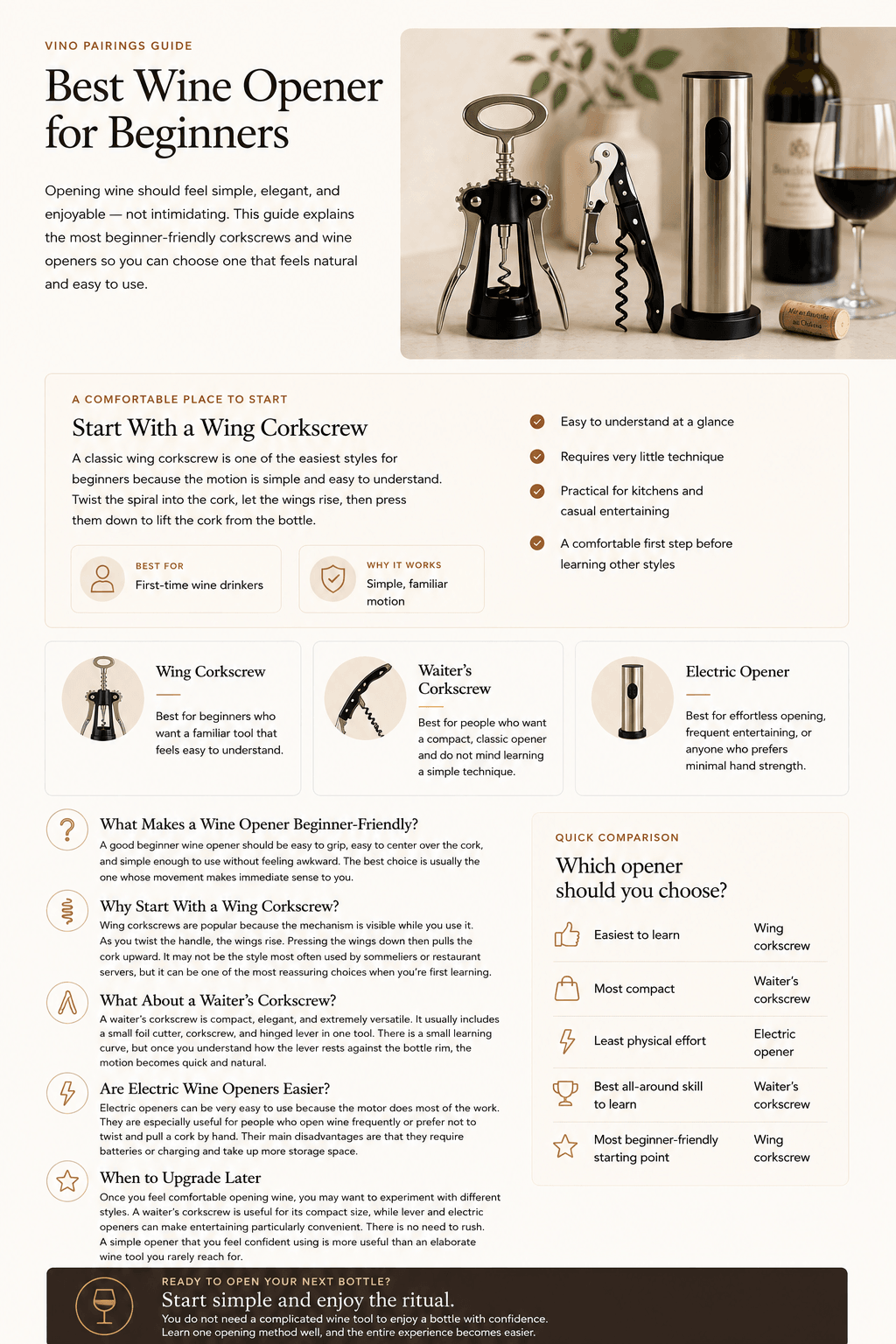
Begin Simply
The best opener is the one you reach for without hesitation.
A wine opener does not need to be complicated or impressive. It simply needs to feel natural in your hand and predictable while you use it.
The Short Answer
Start with a wing corkscrew.
A wing corkscrew is one of the easiest styles to understand because the mechanism shows you exactly what is happening. Twist the spiral into the cork, allow the wings to rise, and press them down to lift the cork free.
Once that motion feels natural, learning a waiter's corkscrew is a useful next step.
Three Ways to Open Wine
Choose the experience that suits you.
The Easiest Beginning
01Wing Corkscrew
Familiar, reassuring, and easy to understand at a glance. The rising wings make the opening motion visible, which can make this style especially comfortable for someone learning.
Best for first-time wine drinkers and occasional bottles.
The Classic Choice
02Waiter’s Corkscrew
Compact, elegant, and wonderfully versatile. There is a small learning curve, but once the leverage becomes familiar, this is one of the most satisfying wine tools to use.
Best for dinner parties, travel, and a classic wine-service ritual.
The Effortless Choice
03Electric Opener
A convenient option when ease matters most. Electric openers handle most of the twisting and pulling, which can make opening several bottles feel almost effortless.
Best for frequent entertaining or minimal hand effort.
“A good wine ritual should feel graceful before it feels impressive.”
How to Choose
Think about the experience, not just the tool.
Each opener solves the same problem in a different way. The best choice depends on whether you value simplicity, tradition, or convenience most.
Choose a wing corkscrew if...
You want the easiest learning curve and prefer to see the mechanism working as you open the bottle.
Choose a waiter’s corkscrew if...
You enjoy the classic wine-service ritual and want a compact tool that becomes more satisfying with practice.
Choose an electric opener if...
You want the least physical effort or often open several bottles while entertaining.
Beginner Notes
A few things worth knowing before your first bottle.
What makes a wine opener beginner-friendly?
Comfortable grip, predictable movement, and simple leverage matter more than complexity. If the motion makes immediate sense, you are more likely to use the tool confidently.
Is a waiter’s corkscrew difficult?
Not really. The only unfamiliar part is learning how the hinged lever rests against the bottle rim. Once that clicks, the motion becomes surprisingly natural.
Are electric openers easier?
Yes, especially if you want to minimize twisting or pulling. The motor does most of the work for you.
Do I need more than one opener?
No. One opener you understand and enjoy using is enough. Additional styles are simply about preference and convenience.
At a Glance
The quick comparison.
One Last Thought
Start simple and enjoy the ritual.
You do not need a complicated wine tool to open a bottle beautifully. Learn one method well and let confidence come with repetition.
Vino Pairings offers approachable guidance for wine, entertaining, pairing, and the rituals that make every pour feel a little more special.